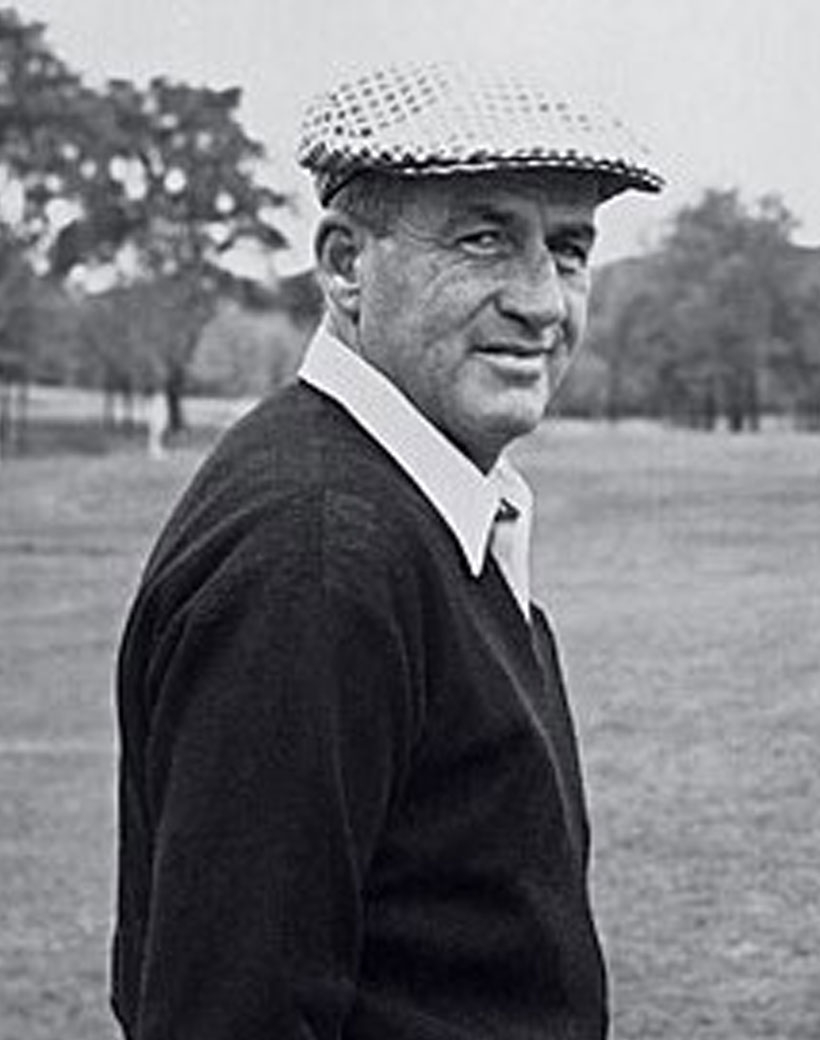


At his peak, Dick Wilson was one of the two most sought-after golf architects in the US, working on nearly 10 courses annually and personally building many of his own designs, a rarity in his field.
Dick Wilson was one of the dominant figures of postwar American golf architecture, a Philadelphia born designer whose bold, aerial style helped define mid 20th century championship golf. From Doral’s Blue Monster to Bay Hill and Laurel Valley, he turned often flat or uninspiring sites into demanding, visually distinctive tests that still echo in modern design debates.
Early life and apprenticeship in Philadelphia
Louis Sibbett “Dick” Wilson was born in Philadelphia in January 1904, the son of a dirt contractor who worked on major construction projects. His father’s firm was involved in building Merion Golf Club’s West course around 1914, and the young Wilson got his first taste of golf construction there, working as a water boy on site. That experience, combined with the region’s rich golf culture, drew him toward course building rather than a traditional college path.
Wilson attended high school in the Philadelphia area and played quarterback on the football team, then briefly enrolled at the University of Vermont before dropping out in 1924. That same year he joined the Philadelphia based architecture firm of Howard Toomey and William Flynn, one of the most important design operations of the Golden Age. Working under Flynn, he learned both design and heavy construction, which would later become central to his own style.
Work with Toomey and Flynn and prewar experience
With Toomey and Flynn, Wilson worked as a construction superintendent and design associate on a number of major projects. He supervised construction when the firm undertook a complete overhaul of Shinnecock Hills Golf Club in 1931, helping transform it into the championship venue that is still used for modern U S Opens. He also played key roles in construction at Cleveland Country Club, both courses at Boca Raton Resort in Florida, The Country Club in Brookline and work at Springdale near Princeton, among others.
The Great Depression reduced new course construction, and Wilson eventually took a job as greenkeeper at Delray Beach Country Club in Florida, deepening his knowledge of turf and maintenance. During World War II he served in the U S Army Air Forces, where he worked on constructing and camouflaging airfields, further sharpening his earthmoving and engineering skills. These experiences would later underpin his ability to transform flat, swampy land into dramatic, tournament ready golf.
Postwar firm and design philosophy
In 1945 Wilson started his own golf architecture firm, with his first solo course completed at West Palm Beach Country Club in 1947. Through the 1950s he became one of the two most sought after architects in the United States along with Robert Trent Jones, particularly after the deaths of William Flynn and Donald Ross left a vacuum of prominent designers.
Wilson’s design philosophy was centered on the aerial game and a balanced examination of all facets of play. He believed a golf course should “require equal use of every aspect of the game, rather than make a disproportionate demand on one or two phases, such as driving or putting.” To respond to rising ball and club distances in his era, he built courses that favored high, precise approach shots into elevated, well defended greens rather than run up play.
His stylistic signatures included:
- Slightly raised greens and tees, particularly in flat Florida sites, to improve visibility and drainage.
- Deep, curvilinear or “amoeba like” bunkers that wrapped around greens rather than simple, round pits, a modernization of earlier rugged styles.
- Greens set on a diagonal axis, often 30 to 45 degrees to the line of play, with a large bunker guarding the ideal angle and rewarding proper positioning in the fairway.
- Extensive use of lakes, created both to supply fill for his elevated features and to add strategic hazard and visual drama.
Robert von Hagge, one of his design associates, later said Wilson pushed within “the history and tradition of the game” but loved “bold expression,” comparing some of his turning doglegs to a speedway, high on one side and low on the other to accentuate angles.
Notable courses
Wilson designed or co designed more than 60 courses, many of which became regular tournament venues and influential examples of mid century design. Some of the most notable are:
- Doral Country Club, Blue Monster, Doral, Florida
Built in 1962 on former swampland, Doral’s Blue Monster became one of the most famous PGA Tour venues, known for its long par 4s, water guarded approaches and windy conditions. Wilson’s routing and water use turned a flat, unpromising site into a fearsome championship test that remained central to the Tour for decades, even though later renovations have altered much of his original work. - Bay Hill Club and Lodge, Orlando, Florida
Completed in 1961, Bay Hill originally reflected Wilson’s elevated greens, strong bunkering and use of water to protect preferred angles. Arnold Palmer later bought and significantly remodeled the course, but Wilson’s routing and basic hole concepts formed the foundation for what is now the annual Arnold Palmer Invitational venue. - Laurel Valley Golf Club, Ligonier, Pennsylvania
Opened in 1960 on rolling farmland, Laurel Valley showcased Wilson’s ability to shape bold greens and hazards on inland terrain. It hosted the 1965 PGA Championship and the 1975 Ryder Cup, and though Palmer later made substantial changes, the club remains closely associated with Wilson’s original design. - Pine Tree Golf Club, Boynton Beach, Florida
Completed in 1962, Pine Tree is often cited as the purest surviving example of Wilson’s style. Ben Hogan famously called it “the greatest flat course in America,” and architect Tom Doak described it as the “ultimate Dick Wilson layout” longer, flatter and more heavily bunkered than most of his other courses. Pine Tree’s elevated greens, deep sand and demanding angles make it a touchstone for students of his architecture. - Royal Montreal Golf Club (Blue / composite), Ile Bizard, Quebec
Around 1958 59 Wilson designed three courses at Royal Montreal, bringing his modern bunkering and green complexes to one of North America’s oldest clubs. The Blue Course, later modified by Rees Jones, has hosted events such as the Canadian Open and Presidents Cup, extending Wilson’s influence into Canadian championship golf. - Coldstream Country Club, Cincinnati, Ohio
Designed around 1959 60 on rolling Midwestern land, Coldstream demonstrates Wilson’s approach outside Florida, with strong bunkering and diagonally oriented greens weaving through tree lined corridors. It has been the subject of historically informed restoration efforts that highlight renewed appreciation for his work. - Cog Hill Golf and Country Club, Courses 3 and 4 (Dubsdread), Lemont, Illinois
In the 1960s Wilson and his firm laid out multiple courses at Cog Hill, including what would become the Dubsdread Course 4, later reworked by Rees Jones. While much has changed, Wilson’s original routing and concept of a rugged, tournament ready public championship course laid the groundwork for Cog Hill’s long role as host of PGA Tour events. - La Costa Resort and Spa, Carlsbad, California
Wilson completed two courses at La Costa around 1965, bringing his brand of water lined hazards and elevated greens to Southern California resort golf. The resort went on to host numerous PGA Tour and World Match Play events, further cementing his national profile.
Other important works include Cypress Lake Golf Club in Florida, Callaway Gardens in Georgia, NCR Country Club in Dayton and Deepdale on Long Island, the latter often cited as one of the clearest expressions of his design intent.
Influence, associates and reputation
Wilson worked closely with a number of associates who later became well known in their own right, including Joe Lee and Robert von Hagge. Joe Lee joined him in 1952 and helped execute many of his later projects before building a large independent portfolio after Wilson’s death. Von Hagge credited Wilson with encouraging boldness in shaping while still respecting the game’s traditions.
From the early 1950s until his death in 1965, Wilson was regarded as one of the premier American architects, his name often mentioned alongside or in competition with Robert Trent Jones. Tee Times notes that by the 1950s Wilson and Jones were the two most sought after designers in the country, effectively defining the look of big time postwar golf.
In later decades, some critics folded Wilson into what they called the “dark ages” of golf architecture, arguing that his emphasis on the aerial game and heavy bunkering departed from the ground game traditions of the Golden Age. However, renewed interest in his work has led to historically minded restorations at clubs like Pine Tree, Hole in the Wall, Coldstream and Bidermann that aim to recover his original intent. Writers at The Fried Egg and Golf Club Atlas have argued that many of his best courses were softened or drastically altered, and that a proper evaluation of his work should focus on sites where his greens, bunkering and angles remain intact.
Interesting facts and legacy
Wilson’s life was relatively short by modern standards he died on July 5, 1965, in his early 60s yet his influence on mid century golf design remains substantial. He came into the field through construction, not formal design training, and was proud of his ability to both draw plans and build them in the dirt, something Links Magazine notes he sometimes used “as a bludgeon” in debates with more theoretical architects.
Even though many of his most famous courses have since been altered, his core ideas elevated greens, deep curving bunkers, water used both strategically and for fill, and the demand for high, well flighted iron shots continue to inform how architects think about championship setups on relatively bland land. For golfers and historians, studying surviving Wilson work at places like Pine Tree, Deepdale or carefully restored Coldstream offers a window into a crucial transitional era between the Golden Age and modern minimalist revival, viewed through the lens of a Philadelphia born constructor who turned engineering skill into a distinct architectural voice.
%203.webp)
%20%236.webp)

%20Hole%2018.webp)