On February 6, 1971, astronaut Alan Shepard did something absurd and wonderful: he hit a golf ball on the moon, making it the only sport ever played anywhere except Earth.
The Sneaky Setup
Shepard, commander of Apollo 14 and a devoted golfer, couldn't resist the opportunity. But NASA's director Bob Gilruth initially said "absolutely no way." The Apollo program was already under scrutiny, and the commander goofing around on the moon seemed reckless.
Shepard, ever the persistent fighter pilot, made his case with a crucial promise: he'd bring the club at no taxpayer expense and only attempt the shot if the mission went perfectly. Gilruth finally relented.
So how do you sneak a golf club onto a spacecraft? Carefully. Shepard enlisted Jack Harden, the pro at River Oaks Country Club in Houston, to create a custom club head from a Wilson Staff 6-iron. The ingenious part? He attached it to a lunar rock-sampling tool, disguising it as scientific equipment. The two golf balls? Hidden in a tube sock and tucked into his spacesuit.
Even the Capcom in Houston was completely in the dark. That was Edgar Mitchell's colleague, who later recalled his shock when Shepard suddenly pulled out the gear on live television.
"That Looked Like a Slice to Me, Al"
After nine hours of serious lunar work, Shepard saw his window. As the astronauts headed back to the lunar module, he casually announced over the radio: "Houston, you might recognize what I have in my hand as the contingency sample return; it just so happens to have a genuine 6-iron on the bottom of it."
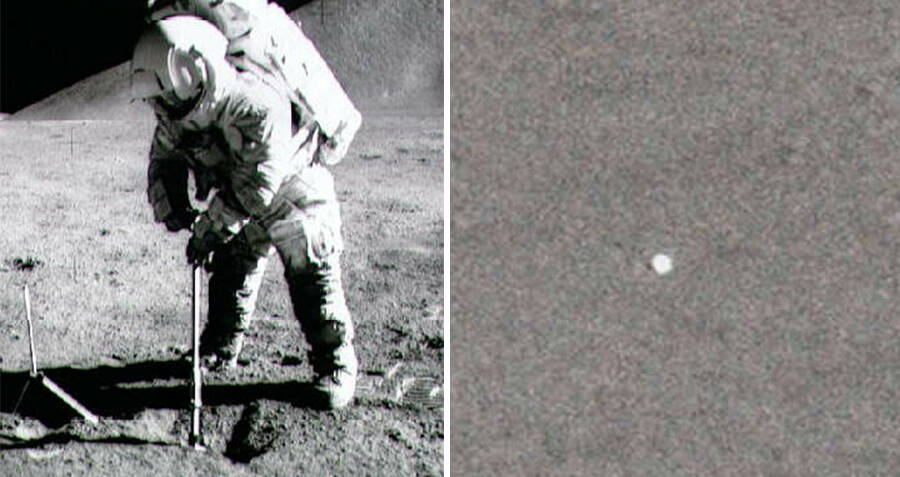
The moment captured on live TV was unforgettable. Shepard, in his bulky spacesuit, took a one-handed swing at the first ball. It veered wildly into a nearby crater. From Houston, Capcom could barely contain himself: "That looked like a slice to me, Al."
Shepard had one more ball. He swung again, sending up clouds of gray lunar dust. The second ball soared out of frame, and Shepard exclaimed what would become one of the most famous declarations in sports history: "Miles and miles and miles!"
The Reality Check: 40 Yards of Legendary Hyperbole
For decades, nobody knew how far that ball actually traveled. Shepard later revised his estimate to a still-generous 200 yards. Could low gravity and no air resistance have sent it that far?
Enter Andy Saunders, a property renovation specialist from England with a passion for Apollo imagery. In 2019, nearly 50 years after the shot, Saunders began analyzing archival photos and video from Apollo 14. Using original Hasselblad camera stills and satellite imagery, he identified the balls, Shepard's footprints, and the divots from his swings.
The truth? Shepard's famous second shot traveled approximately 40 yards.
But context matters. Shepard was swinging one-handed in a bulky spacesuit with thick gloves, on a surface covered with rocks and footprints. "He didn't get preferred lies; he just dropped the ball," Saunders noted. "To even make contact was quite impressive."
When Congress asked about the stunt, Shepard quipped: "I did this since I am patriotic and concerned about the security of the nation." - Lol.
The "Miles and Miles" Paradox
Here's the fascinating part: Shepard's exaggeration contains a kernel of truth. Saunders calculated that if a pro golfer could replicate proper head speed on the moon at the right launch angle, the ball would travel approximately 3.41 miles in the low gravity and vacuum.
"So, amusingly enough, that is indeed miles and miles as Shepard stated," Saunders added. Given ideal conditions, Shepard was right all along.
Still Waiting on the Moon
Both golf balls remain on the moon exactly where they landed, undisturbed for over 55 years. The club head was brought back and donated to the USGA Museum in New Jersey. Estimates suggest each ball could fetch upward of $10 million at auction if recovered during a future Artemis mission.
Fifty-five years later, those 40 yards remain the greatest golf shot ever taken, not because of the distance, but because it was the only one that mattered beyond Earth. Somewhere on the lunar surface, two white balls are waiting, preserved in the vacuum, ready for someone else to eventually take their swing at golf's most legendary course.