
Amazon just dropped a golf ball that costs less than a hot dog at the turn. Surprisingly, it doesn't play like one.
When Amazon launched its first golf ball at approximately $1 per ball, the golf world braced for impact. Would the e-commerce giant's entry into a market dominated by premium brands like Titleist Pro V1 and TaylorMade TP5 be a laughable novelty or a legitimate disruption? After months on the market, multiple professional reviews, and a 4.5-star rating on Amazon, the verdict is in: the Amazon Basics Core Soft is a surprisingly solid performer that's rewriting expectations for budget golf equipment.
The timing couldn't be better. Golf equipment costs have climbed steadily in recent years, creating barriers for newcomers and budget-conscious players. While premium tour balls command $5 to $15 per ball, Amazon's offering undercuts even entry-level competitors like Titleist TruFeel and Callaway SuperSoft by 66 to 87 percent. That's not a typo. You can buy a dozen Amazon Basics balls for less than three Pro V1s.
Construction and Design
The Amazon Basics Core Soft follows a tried-and-true formula: two-piece construction with a soft ionomer cover and low-compression core. At approximately 55 compression, it sits on the softer end of the market spectrum, designed to help players with slower to moderate swing speeds generate ball speed without sacrificing feel. There's no cutting-edge technology here, no urethane cover, no multi-layer core. Just straightforward, minimalist design focused on accessibility.
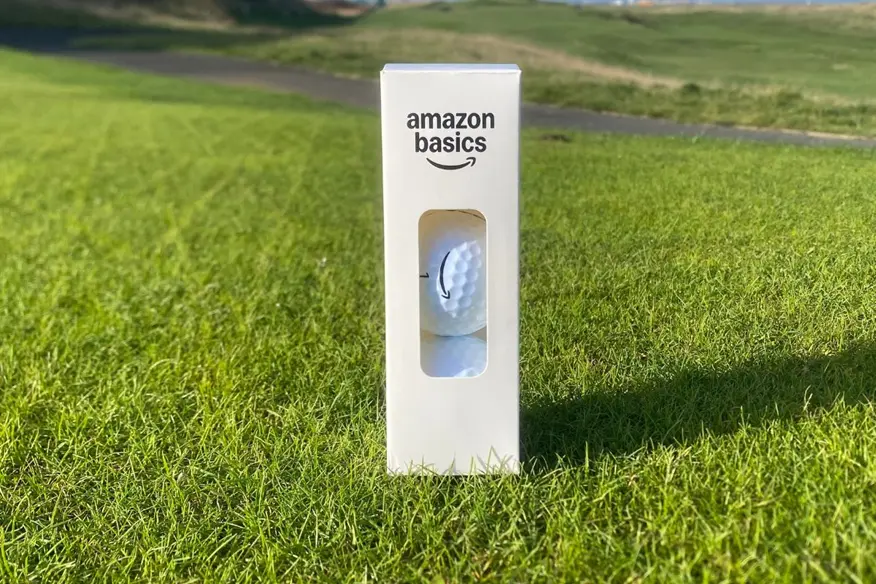
The packaging reflects this philosophy too. Amazon's eco-friendly, no-frills approach means you won't find glossy marketing claims or performance charts on the box.
Performance: Better Than Expected, But With Trade-Offs
GolfMagic's launch monitor testing revealed some eye-opening data. The Amazon ball produced 143.3 mph ball speed and 240-yard carry with driver, outperforming direct competitors like the Titleist TruFeel (139.8 mph, 229 yards) and Wilson Duo Soft (136.8 mph, 221 yards). That's impressive for a ball at this price point, though it still trails premium offerings by 5 to 20 yards depending on swing speed.
The feel is legitimately soft across the bag, particularly with scoring clubs. Multiple reviewers noted the supple feedback and reasonable response off the clubface. However, the sound profile tells a different story. The ball produces a slightly clicky, muted sound with wedges and a somewhat plasticky feel on the putter.
Greenside performance reveals the biggest compromise. The Amazon ball generates approximately 5,000 rpm on 50-yard pitches, compared to 7,000 rpm with a Pro V1x. That 2,000 rpm deficit translates to less stopping power and control around the greens. Wedge spin rates hover in the 6,000 to 7,000 rpm range, below the 7,000-plus standard for premium soft-feel alternatives.
Golf Monthly observed that the ball produces "underwhelming" down-range performance despite acceptable feel and value. The trajectory tends to balloon with excessive backspin, leading to energy loss and inconsistent distance control. GolfMagic identified consistency as the key trade-off, noting variable performance shot-to-shot with the same club.
Who Should Play This Ball?
The Amazon Basics Core Soft isn't trying to compete with tour-level balls, and that's perfectly fine. It's designed for beginners, high-handicap players (9-plus handicap range), and golfers prioritizing affordability over maximum performance. If you're losing three balls per round or just getting into the game, spending $50 on a dozen premium balls makes little sense.
"This is very much a no-frills, two-piece soft feel golf ball in the mould of models like Titleist's TruFeel, Callaway's SuperSoft and Srixon's AD333," GolfMagic noted. The publication concluded that "for this level of golfer the Amazon Basics is both easy to hit and an able performer compared to models that'll generally set you back more than £10 more per dozen."
Golf Monthly added: "The Amazon Basics Core Soft ball is an extreme budget, soft-feel ball. It's a viable option for those just getting into the game who want a soft-feeling ball, but more experienced golfers will look for more performance at the top end of the bag."
Market Disruption and Industry Impact
Amazon's entry represents more than just another budget ball option. It's a direct challenge to golf's traditional pricing structure and accessibility barriers. The $1 price point has generated viral attention, making it one of the biggest equipment stories of recent years. YouTube reviewers, launch monitor testers, and golf media outlets have all weighed in, documenting performance data and on-course results.
The ball has achieved something remarkable: it's changed the conversation around value in golf equipment. When a $1 ball can hold its own against $3 to $8 entry-level competitors, it forces consumers and manufacturers alike to reconsider what they're paying for.
Traditional manufacturers now face pressure on pricing accessibility. While Titleist, TaylorMade, and Callaway still dominate the premium segment with superior technology and performance, Amazon has carved out a legitimate space at the opposite end of the spectrum.
The Bottom Line
The Amazon Basics Core Soft won't replace your Pro V1s if you're a single-digit handicap chasing tour-level spin and consistency. But that's not the point. This ball succeeds by delivering solid entry-level performance at an unprecedented price. GolfMagic summed it up perfectly: "While its performance is by no means spectacular... making it a near irresistible bargain at its price point."
For the golfer who's tired of donating $5 balls to the water hazard on 17, or the beginner who just wants something soft and affordable to learn with, Amazon has delivered. The Core Soft isn't perfect, but at $1 per ball, it doesn't have to be. It just has to be good enough. And surprisingly, it is.