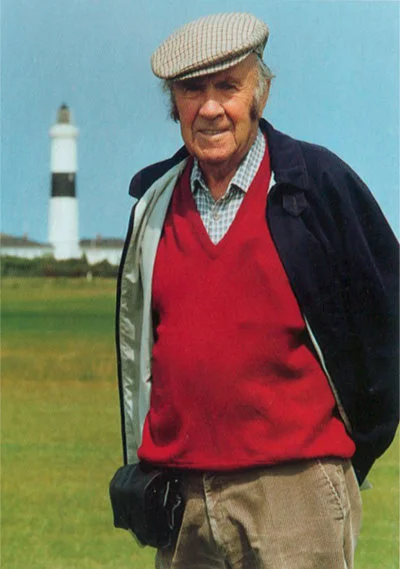
Donald Harradine held a golf handicap of +5 for many years, reflecting his elite playing ability alongside his design expertise.
Donald Harradine may not be a household name to American golf fans, but for anyone who has logged miles on continental European fairways, his work is everywhere. Born in London in 1911, he became one of Europe’s most influential post‑war golf course architects, shaping hundreds of layouts from the Alps to the Mediterranean with a quiet, strategic style that still defines how much of Europe plays golf today.
Early life and path into architecture
Donald Leslie Harradine was born in Enfield, north London, in 1911, and discovered golf at an early age. His stepfather, Albert Hockey, was a golf professional at Shooter’s Hill Golf Club, upgrading and remodeling courses, making his own clubs, and even teaching in one of Harrods’ early indoor golf facilities. Growing up in that environment, Harradine absorbed the game from every angle and developed into a highly skilled player, reportedly reaching a handicap of +5 that he held for many years.
In 1929, still a young man, he took his first opportunity as a golf course architect on the continent, working in Switzerland. He rebuilt the course at Bad Ragaz into what contemporary accounts described as a prototype modern layout and soon decided to stay in Switzerland, despite the economic difficulties of the era. Winters were lean enough that he supplemented his income with jobs such as working as a librarian at the Grand Hotel St. Moritz, but the foothold in the Alps would define his career.
Building a pan‑European career
From that first Swiss project in 1929, Harradine steadily built a practice that followed the growth of golf across continental Europe. He spent early periods in Davos, Vulpera, Flims and Bern, designing and building nine‑hole and hotel courses that brought golf to mountain resorts and emerging destinations. His first designs were steeped in the tradition of English parkland golf, but executed in alpine valleys and high‑altitude settings where golf was still a novelty.
After the Second World War, new commissions arrived as Europe rebuilt, and Harradine eventually settled in Caslano near Lugano in southern Switzerland. Over a “lengthy and inspiring” career, he designed, built or rebuilt “hundreds” of courses, with his family firm Harradine Golf later recording more than 200 projects across Europe, Africa, Asia and the Middle East. His work reached a remarkable range of landscapes, from arid, saline deserts to humid grasslands, wetlands, swamps, mountains, coastal sites and even waste tips, often at altitudes up to around 1,850 metres.
By the time he retired in the 1980s, Harradine’s influence on European golf was described as “recognizable everywhere,” particularly on the continent where many of the first generation of post‑war clubs played over his routing. He died on 16 September 1996 in Caslano, on a street fittingly named Via Golf, but his family and firm have continued the Harradine name in golf design into the modern era.
Design philosophy: simple, natural, and quietly demanding
Harradine’s design philosophy can be summed up as natural integration first, strategy second, and earthmoving a distant third. He aimed for the “simple and uncomplicated integration of the course into the natural landscape” while still producing a “tough but fair” challenge, a balance that made his layouts playable for regular members yet engaging for low‑handicap players. He believed a course should sit unobtrusively in its setting, at an “intrinsic” level with the landscape rather than imposed upon it, which led to routing that followed existing contours rather than wholesale reshaping.
One of his great strengths was working on small or problematic sites, often with severe budget constraints. Contemporary descriptions note that he became a specialist in constrained, alpine terrain, learning how to construct and maintain turf at high altitudes and in difficult climates, and he was “virtually second to none” in squeezing full‑blooded golf out of limited acreage. His bunkering tended to be sparing on fairways, with more emphasis placed on strategically positioned trees and natural landforms to create angles, options and psychological pressure.
Harradine’s guiding principles underscored his pragmatic streak. He famously said, “It is better to have a good par 69 course than a poor par 72,” a line that captures his preference for quality of holes over arbitrary yardage or par. Another of his axioms targeted club politics more than strategy: he believed the executive committee of a golf club should always have an uneven number of members—and that three were already too many, a wry comment on how bureaucracy can hinder good decisions.
Above all, he never forgot that “golf is played between the ears and that nothing could be achieved by brute force.” His courses were designed to provide fun and pleasure for the average player while offering a genuine test for low handicappers, relying on thought, position and nerve rather than sheer length or penalty.
Notable courses and achievements
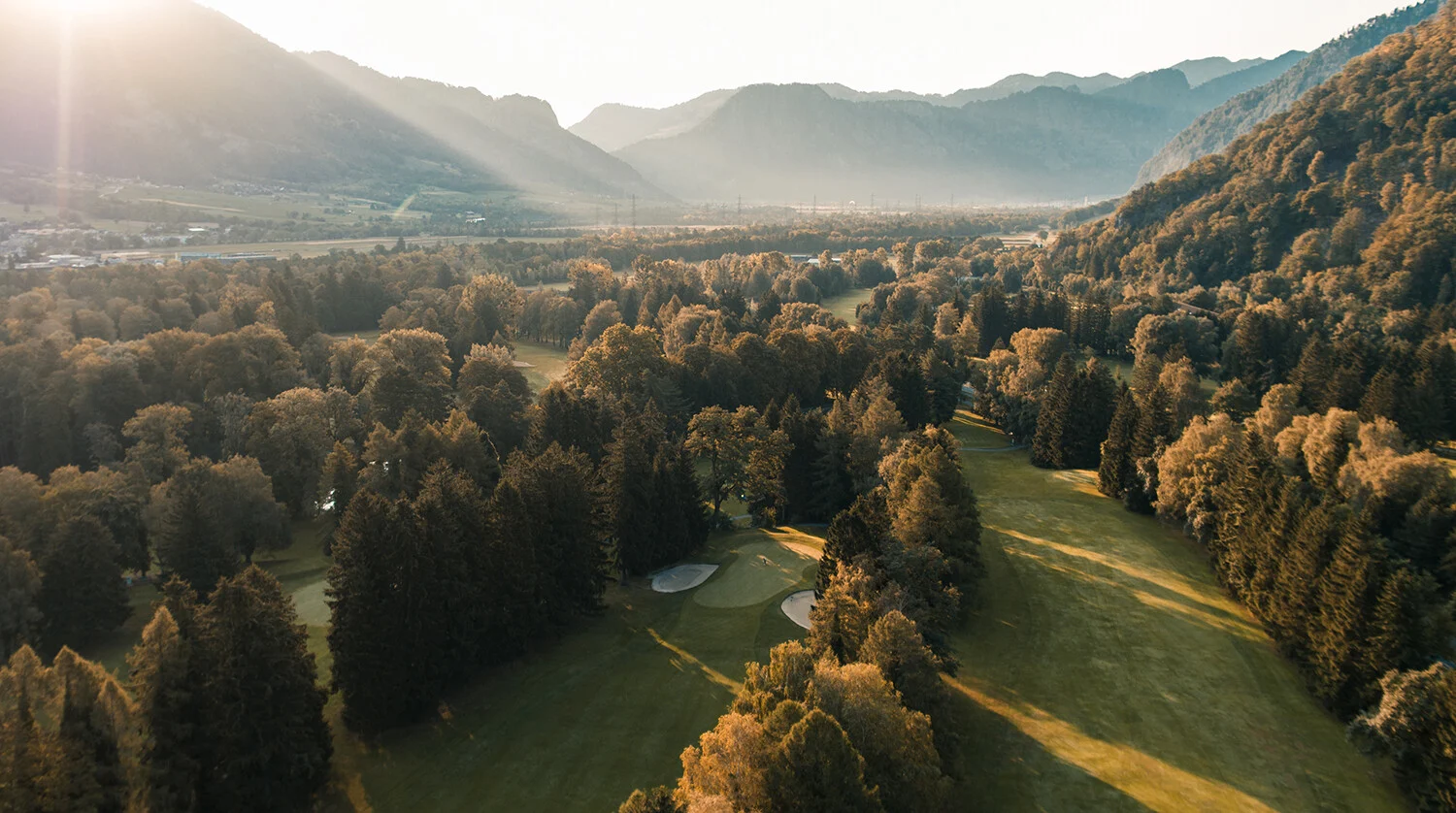
Given his vast output, it is impossible to list every Harradine course, but several projects stand out as emblematic of his contribution to European golf. In Switzerland, his early work at Bad Ragaz laid the foundation for one of the country’s best‑known resort courses, and he later returned in the 1950s in partnership with Fred Hawtree to redesign the 18‑hole layout, refining both landscape construction and high‑altitude agronomy. These Swiss hotel and resort courses in Davos, Arosa and other alpine towns were crucial in establishing Switzerland as a serious golf destination.
In Bavaria, Harradine’s designs effectively mapped onto the spread of golf across the region. He laid out the first six holes at Tegernsee Golf Club in Bad Wiessee in 1958, with three additional holes following in 1961, giving the club a distinctive hillside character. He created the first nine holes at Regensburg in 1968 and later extended it to a full 18 in 1981, then went on to design the 18‑hole Sonnenalp course in the Allgäu in 1975, widely regarded as one of southern Germany’s most scenic venues. Further projects included expanding the Augsburg course to 18 holes in 1980 and the Oberfranken course in 1984, leaving his mark “in almost every corner” of Bavaria.
Beyond the German‑speaking world, Harradine had a major hand in some of continental Europe’s most picturesque layouts. At Bled in what is now Slovenia, he led a major revival and redesign of the course in 1972, transforming it into what the club now calls one of the most attractive and famous courses in Europe, framed by the Julian Alps and Lake Bled. During construction, he reportedly gave the first golf swings and demonstrations to locals, helping seed the game in the region and paving the way for the founding of Golf Club Bled in 1975.
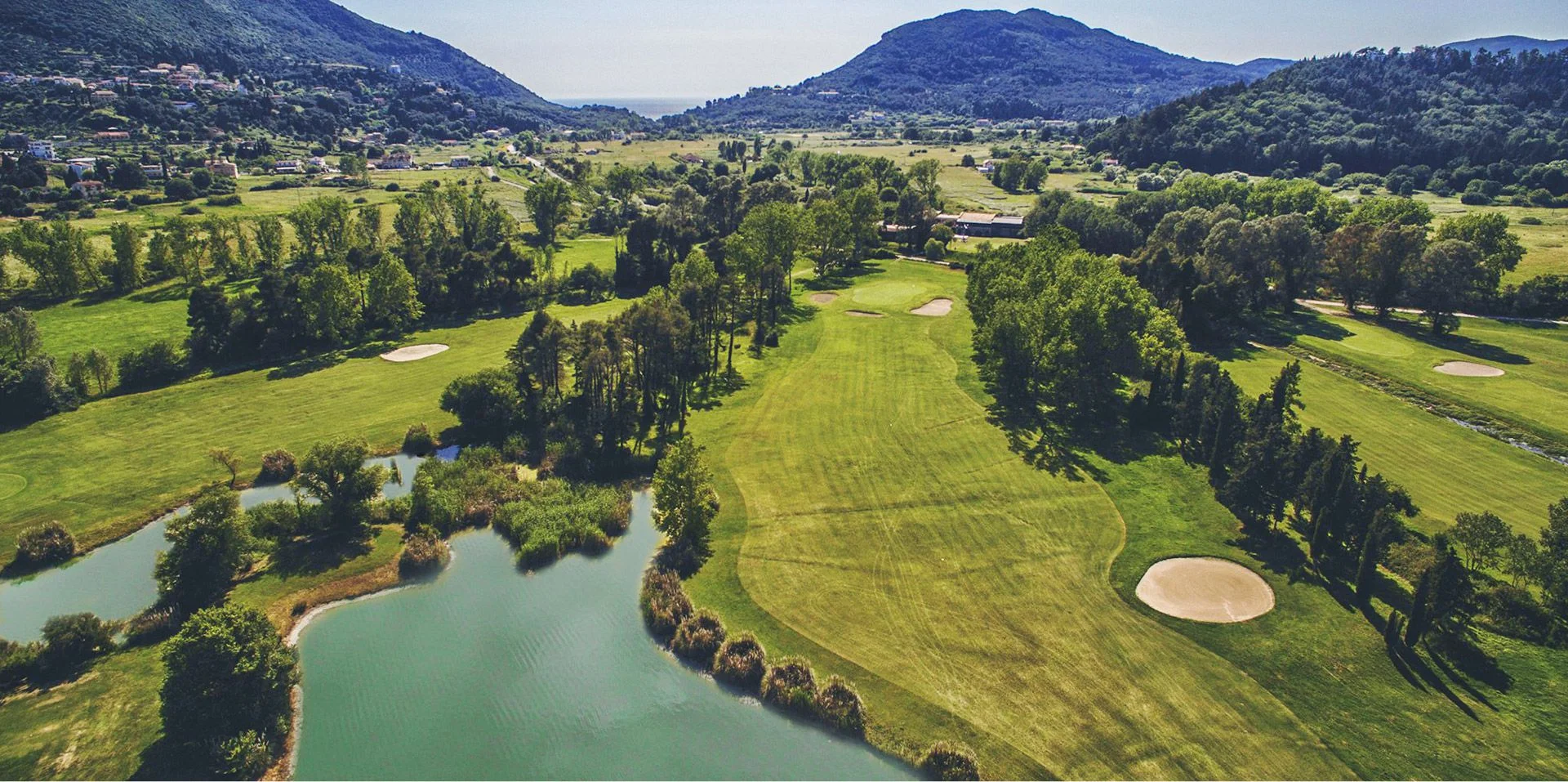
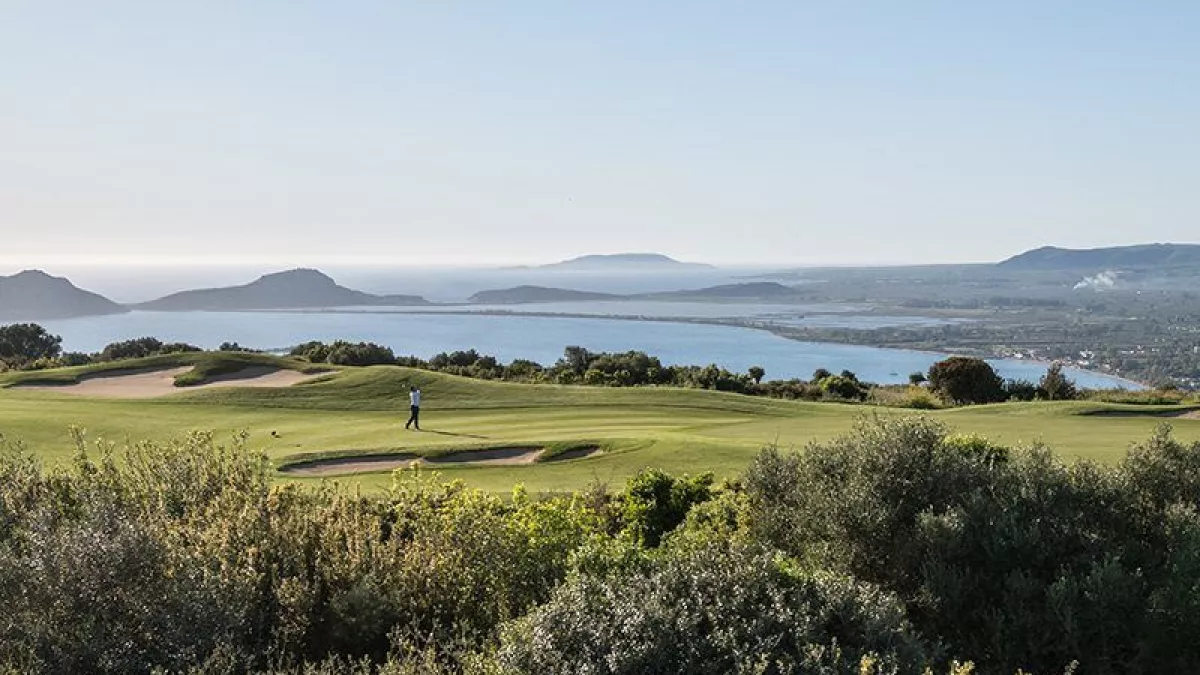
Harradine also took golf to new countries and markets. In Greece, he built the Glyfada course outside Athens in 1962, recognized as the country’s first modern golf course, and his firm later designed the course on Corfu that built a loyal following of repeat visitors. Over time, Harradine Golf’s portfolio spread far beyond Europe to places like Egypt, Morocco, Oman, Qatar, the United Arab Emirates, India, Kazakhstan and more, often providing inaugural or early‑generation courses in emerging golf nations.
Many Harradine courses have hosted national opens and professional tournaments, and several have won regional awards, though the designer himself preferred to let his work speak quietly through everyday play rather than marketing fanfare.
Leadership, associations and legacy
Harradine was not only a prolific architect but also a foundational figure in the professionalization of golf course design and maintenance in Europe. He was a founder member of the British Association of Golf Course Architects (now the British Institute of Golf Course Architects) and later a founder of the European Society of Golf Course Architects, helping to set standards and ethics for the profession. These organizations positioned architects as guardians of both strategic quality and environmental sensitivity, roles Harradine took seriously in his own work.
Along with his wife Babette, he also turned his attention to the people who care for courses on a daily basis. In 1969 they founded what became known as the International Greenkeepers’ Association, later also called the European Greenkeepers Association, to improve education and recognition for greenkeepers, a role he felt was poorly understood and under‑appreciated on the continent. Sponsored by equipment manufacturers and industry partners, the Harradines organized seminars, workshops and multilingual bulletins covering new maintenance techniques and everyday challenges in turf care.
This commitment to greenkeeping dovetailed with his design approach. Harradine prioritized courses that could be maintained with minimal resources, integrating sustainable ecological solutions and resisting the temptation to design “unplayable monuments to ecology,” as his firm later put it. The goal was always a course that belonged to its site, played fairly in its climate, and could be kept in good condition without extravagant budgets.
His legacy also carries on literally through his family. His son Peter Harradine became a prominent architect in his own right, operating from Dubai and working across the Middle East, while grandson Michael has also followed in his footsteps, ensuring that the Harradine name remains an enduring presence in global golf course architecture.
Interesting facts and enduring influence
A handful of anecdotes and details help bring Donald Harradine’s personality and influence into focus. He was self‑taught as an architect, drawing heavily on the tradition of old English parkland courses and adapting those ideas to alpine and continental environments. His ability as a player—holding a +5 handicap at his peak—gave him an intuitive sense of shot values, angles and wind that translated into designs which challenged better players without overwhelming the average member.
His career effectively tracked the spread of golf in continental Europe, to the point where one modern writer described him as “European golf’s wandering minstrel.” If you have played widely across Switzerland, Germany, Austria, Slovenia, Greece or beyond, the odds are high you have teed it up on a Harradine course, even if you did not notice the name on the scorecard. In Greece, his impact is marked not only by courses like Glyfada but even by a street near the club named “Donald Harradine Road,” a small but telling sign of local appreciation.
Harradine’s partner‑style collaboration with clubs and committees was mirrored in his humorous but pointed dictum about governance: an uneven‑numbered board, and preferably fewer than three, to keep politics from stalling progress. This sense of practicality, mixed with a touch of dry English wit, runs through his many aphorisms and design choices, always emphasizing that courses exist for the enjoyment of golfers rather than to satisfy egos or blueprints.
In today’s age of minimalism and sustainability, much of Harradine’s thinking feels prescient. He championed natural landforms, modest earthmoving, maintainable turf and strategic interest over sheer scale, and he did so decades before these ideals came back into fashion. For golfers exploring continental Europe, recognizing his name can add a layer of appreciation: many of those subtly challenging doglegs, cleverly contoured greens and quietly scenic routings trace back to Donald Harradine, the London‑born architect who gave European golf so much of its modern character.